Signs of Termites in the House: Walls, Wood & Early Clues
Quick answer
The signs that give termites away in a house: pencil-wide mud tubes on foundations, a swarm of winged termites, discarded wings on windowsills, small hexagonal droppings (frass), wood that sounds hollow or crumbles, bubbling paint with no plumbing cause, and doors or windows that suddenly stick. Any one of them justifies a professional inspection.
Most homeowners discover termites months or years after the colony moved in, because the insects work inside wood and soil where nobody looks. The good news: every species leaves physical evidence, and learning the signs turns an invisible problem into a visible one. The seven to check for, in the order most homeowners spot them:
- A swarm of winged termites indoors or around lights — details in our flying termites guide.
- Discarded wings in small identical piles on windowsills and door frames.
- Mud tubes on foundation walls, piers and garage walls.
- Termite droppings (frass) — pellet piles that look like sawdust or pepper (identification guide).
- Wood that sounds hollow or crumbles under light pressure.
- Bubbling paint or buckling drywall with no plumbing leak to explain it.
- Doors and windows that suddenly stick because frames have warped.
Below: each sign in detail, how the evidence differs by termite type, and a 15-minute self-check circuit. If you find any of them, the next step is a documented termite inspection.
The Classic Signs of Termites, Explained
1. Mud Tubes on Foundations and Walls
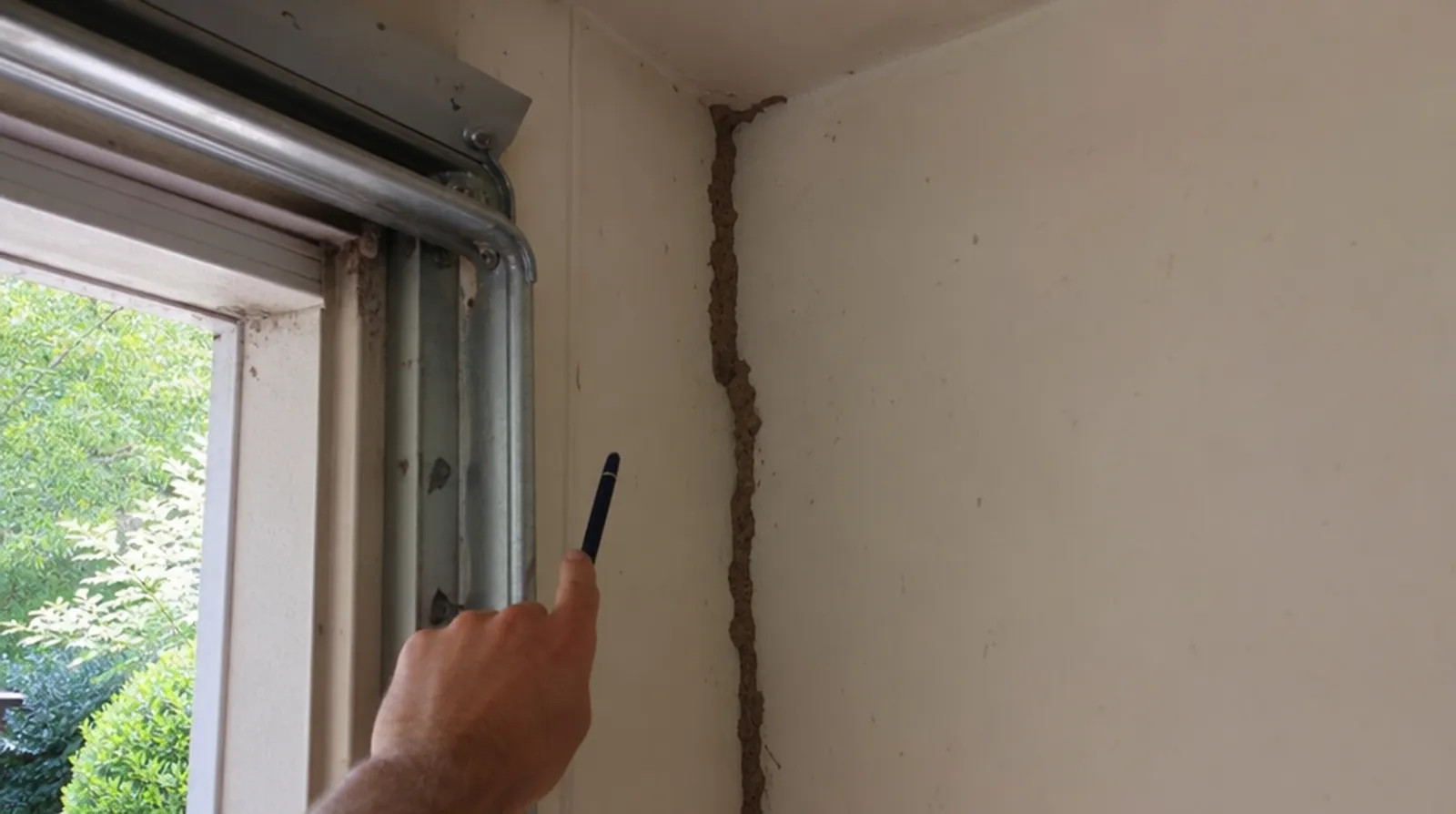
Subterranean termites — the most destructive group in the US — cannot survive open air, so they build protective tunnels out of soil and saliva. These mud tubes are about the width of a pencil, brown, and run up foundation walls, along crawl-space piers, over expansion joints and into garages.
An intact, moist tube usually means an active colony. A dry, crumbling tube can mean the colony moved — or simply rerouted. Break open a short section: if it is repaired within a few days, the infestation is live. Termite mud tubes are the single most reliable sign of subterranean termites, which cause the large majority of structural damage nationwide.
2. Swarmers and Discarded Wings
Yes, termites fly — at least the reproductives do. Once a year, mature colonies release winged termites (swarmers, also called alates) to pair up and start new colonies. Swarm season varies by species and region: spring in most of the South, late summer into fall for drywood termites on the coasts — see our state-by-state termite guides for local timing, and the flying termites guide for the full swarm calendar and what a swarm indoors versus outside means.
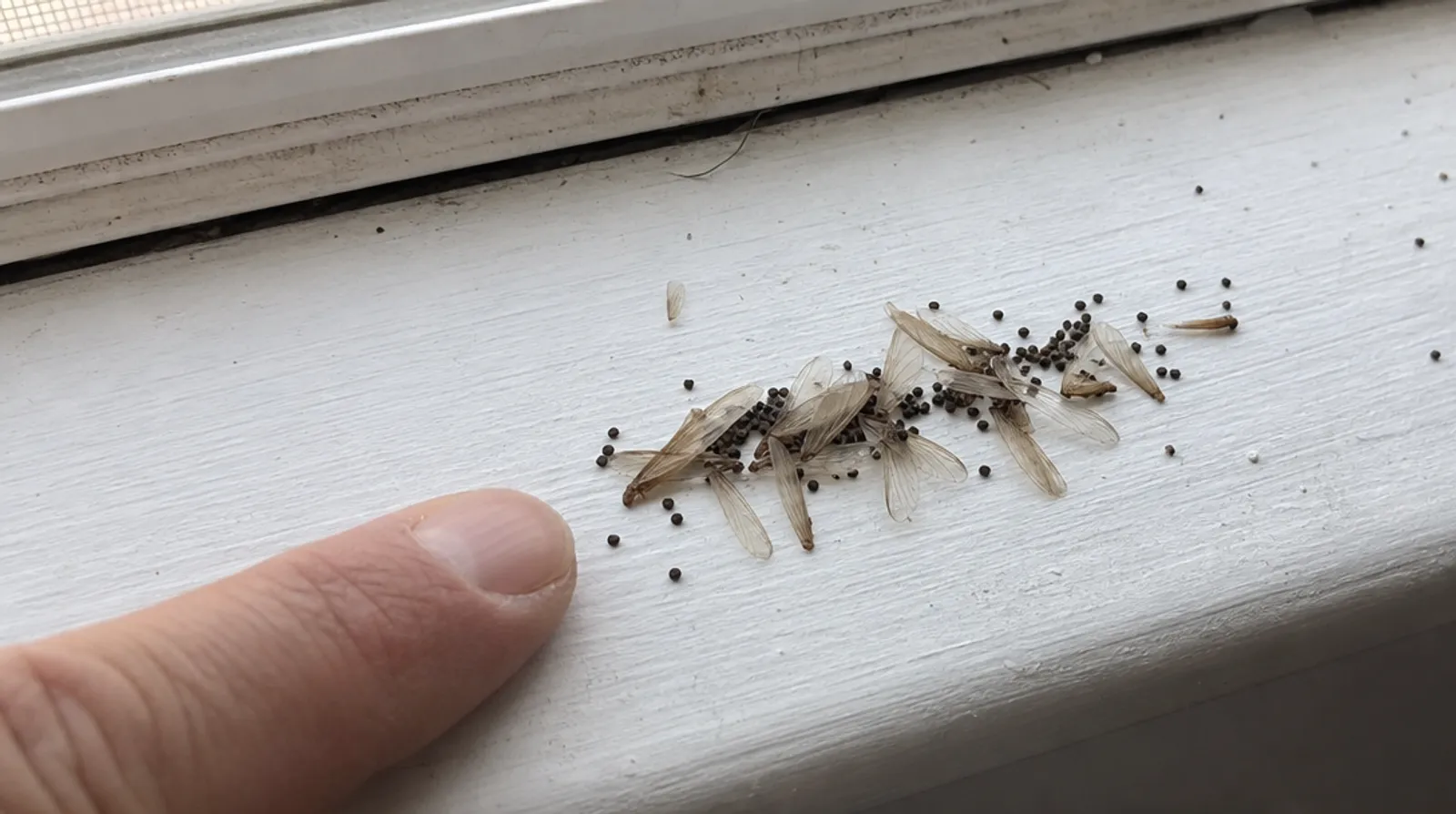
The swarm itself lasts under an hour, but the evidence lingers: small piles of identical, papery wings on windowsills, near door frames, around porch lights and in spider webs. Wings are shed immediately after landing, so a pile of wings with no insects in sight is still proof a colony is nearby — possibly already inside the structure. Note that roughly half of all reported “termite swarms” turn out to be flying ants — our termites vs ants guide settles the identification in seconds.
3. Termite Droppings (Frass)
Drywood termites live entirely inside the wood they eat and push their waste out through pin-sized “kick-out holes.” The droppings, called frass, are hard, six-sided pellets about 1 mm long, ranging from tan to almost black depending on the wood. They collect in small mounds that look like sawdust, coffee grounds or scattered pepper — on floors, window sills, furniture or the top of baseboards directly below the infested member.
Frass is the signature sign of drywood termites, which are common in Florida, California, Hawaii and the Gulf Coast. If you vacuum a pile up and it reappears within days, the colony is active right above that spot. For a detailed identification — frass versus sawdust, carpenter ant debris and cockroach droppings — see the termite droppings guide.
4. Hollow-Sounding or Damaged Wood
Termites eat wood from the inside out, following the grain and leaving a thin veneer of surface wood or paint intact. Tap baseboards, door frames, window trim and exposed beams with a screwdriver handle: infested wood sounds papery or hollow, and light pressure can punch straight through a surface that looks perfectly fine. Galleries inside the wood feel smooth and mud-lined (subterranean) or clean and sanded-smooth (drywood).
Early-stage drywall signs of termites include faint trails under the paint or wallpaper and small pinholes where workers broke through. For a full picture of what the destruction looks like and how to confirm it is termites rather than moisture, see our guides to termite damage and termite damage vs wood rot.
5. Bubbling Paint and Distorted Surfaces
Subterranean termites bring moisture into walls, and that moisture shows: paint that bubbles or peels with no plumbing leak, drywall that buckles, laminate flooring that blisters, and doors or windows that suddenly stick because frames have swollen or warped. Each of these has other possible causes — but in termite territory, unexplained moisture damage in a dry house deserves a closer look.
Signs by Termite Type
Different species leave different evidence. Knowing which type you are dealing with shapes everything that follows — inspection scope, treatment method and cost.
| Sign | Subterranean | Drywood | Formosan |
|---|---|---|---|
| Mud tubes | Yes — signature sign | No | Yes, often extensive |
| Frass pellets | No | Yes — signature sign | No |
| Swarm timing | Spring, daytime, after rain | Late summer–fall, often at dusk | Late spring, at night |
| Where signs appear | Foundation, crawl space, sill plates | Attics, furniture, window trim, exposed beams | Walls, roofs, large carton nests |
| Typical region | Nationwide | Coastal South & West | Gulf Coast, HI, southern CA |
Formosan termites are an aggressive subterranean species; their colonies are larger and their swarms heavier — see the Formosan termites guide. If you are unsure what you are looking at, our types of termites guide goes deeper into identification, and what termites look like covers the insects themselves.
Where to Look: A 15-Minute Self-Check
You do not need tools beyond a flashlight and a screwdriver. Once or twice a year, walk this circuit:
- Foundation perimeter (outside): look for mud tubes, especially behind downspouts, hose bibs and shrubs touching the wall.
- Crawl space or basement: check piers, sill plates, floor joists and any wood-to-soil contact — scrap lumber left under the house is a classic starter colony.
- Window sills and door frames: discarded wings, frass piles, sticking frames.
- Attic and garage: exposed rafters and stored cardboard or firewood — firewood stacked against the house is a frequent entry point.
- Walls: faint trails under paint, pinholes in drywall, and baseboards that sound hollow when tapped — termites inside walls rarely show themselves directly.
- Trees, stumps and fences in the yard: termites on trees near the house are not automatically a structural problem, but an active colony within a few feet of the foundation is a red flag.
- Apartments and condos: check baseboards and around bathroom/kitchen plumbing penetrations, and report findings to the property manager — treatment in multi-unit buildings is the landlord’s responsibility in most states.
What to Do If You Find a Sign
Do not spray the visible insects or tear open tubes and walk away — disturbing them scatters the colony and makes the inspector’s job harder. Instead:
- Document it. Photograph the tubes, wings, frass or damaged wood, and keep any specimens.
- Get a professional inspection. A standard termite inspection typically costs $75–$250, and many companies waive the fee if you proceed with treatment. The inspector will confirm the species, map the extent and put findings in writing — that written report matters later for real-estate transactions (see our guide to the termite letter / WDIR).
- Compare treatment options. If activity is confirmed, treatment typically runs $225–$2,500 for liquid or bait-station methods, with full-structure tenting for drywood infestations at $2,000–$8,000 depending on home size. Details are in our termite treatment and treatment cost guides, and the choice between liquid barriers and bait stations is covered in liquid vs bait.
- Fix the conditions. Leaks, wood-to-soil contact and poor drainage invite the next colony — most treatment plans include these corrections.
Licensing rules, disclosure requirements and common species vary by state, so check the termite guide for your state for local specifics.
Do you have termites? A 2-minute self-check
Check everything you have actually seen in or around your home in the past year. The details behind each sign are in our signs of termites guide.
Frequently asked questions
What do termite droppings look like?
How do I tell flying termites from flying ants?
What are the first signs of termites most homeowners notice?
Can you have termites and see no signs at all?
How long can termites go unnoticed?
Does homeowners insurance cover termite damage or treatment?
Is sawdust always a sign of termites?
Last updated: 2026-08-24