Termites vs Ants: How to Tell the Difference
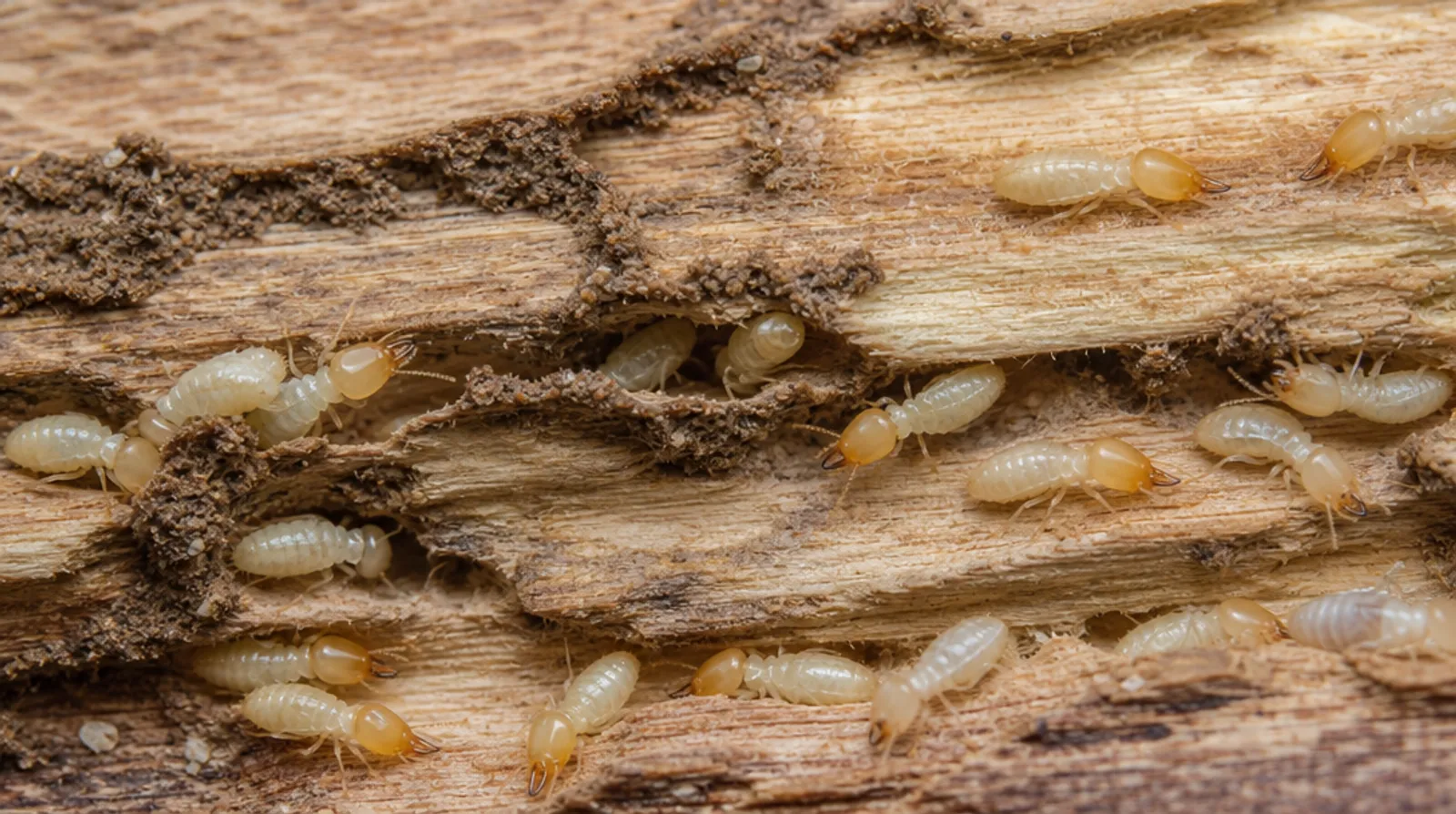
Quick answer
Three checks separate a termite swarmer from a flying ant: termites have a broad, straight waist while ants have a pinched one; termite antennae are straight and bead-like while ant antennae are elbowed; and termites carry two pairs of equal-length wings while an ant's front wings are clearly longer than the rear pair. Termites also shed their wings right after landing, so piles of identical wings point to termites. If the insects are termites, book a professional inspection ($75–$250) — a swarm means a mature colony is nearby.
Every warm season, the same scene plays out in homes across the country: a cloud of small winged insects appears at a window, a porch light or a patio door, and the homeowner reaches for the phone — half convinced it is termites, half hoping it is “just ants.” The confusion is understandable. Termite swarmers and flying ants look alike at a glance, emerge in the same warm, humid weather, and often appear in the same weeks of the year. Roughly half of all “termite swarms” reported by homeowners turn out to be ants.
The stakes, however, are completely different. A flying ant is a nuisance. A termite swarmer is a press release from a mature colony that may already be eating your framing — part of the roughly $5 billion in property damage termites cause in the US every year, almost none of it covered by homeowners insurance. Telling the two apart takes about ten seconds once you know where to look.
Termite Swarmer vs Flying Ant: The Quick Comparison
Both insects are winged reproductives leaving an established colony to mate and start new ones. Three body features — plus what happens after they land — settle the identification:
| Feature | Termite swarmer | Flying ant |
|---|---|---|
| Waist | Broad and straight — body is one continuous tube | Narrow, pinched “wasp waist” |
| Antennae | Straight, bead-like | Elbowed (bent at an angle) |
| Wings | Two pairs of equal length, about twice the body | Front pair clearly longer than the rear pair |
| Body | Dark brown to black, softly segmented | Often reddish-brown, sharply segmented |
| After the flight | Sheds all four wings immediately — piles of identical wings | Keeps its wings much longer; no wing piles |
Color alone is a weak clue — carpenter ants are dark too — so rely on the waist, antennae and wings. One insect in hand is enough; you do not need to compare the two side by side.
The Three-Point Check, Up Close
Waist
The waist is the fastest check and the only one visible from a few feet away. A termite’s thorax and abdomen join broadly, so the whole body reads as one straight-sided tube with no narrowing. An ant’s body is pinched into three distinct segments with a thin, node-like waist between the thorax and abdomen — the classic “wasp waist.” If the insect has an obvious hourglass silhouette, it is an ant.
Antennae
Get closer — or zoom in with your phone camera. Termite antennae are short, straight and look like a tiny string of beads pointing forward. Ant antennae are longer and bend sharply at the first joint, like an elbow. This check requires a still specimen or a good photo, but it never lies.
Wings
Both insects carry four wings, but the proportions differ. A termite’s two wing pairs are the same length — each roughly twice the body length — giving the insect a uniform, paddle-like outline in flight. The wings are papery and translucent with a milky sheen. An ant’s front wings are noticeably longer than its rear pair, so the wing profile looks uneven. Termite wings are also fragile by design, which leads to the most useful clue of all.
Discarded wings
Termites shed their wings within minutes of landing, snapping them off at a built-in fracture point at the base. That is why a swarm so often leaves behind small piles of identical, equal-sized wings — on windowsills, near door frames, around porch lights and in spider webs — with no insects in sight. Ants keep their wings far longer, so they do not leave wing piles. A windowsill covered in matching wings is, by itself, strong evidence of termites, and it is one of the classic red flags in our signs of termites guide.
Does It Matter Which One You Have?
Yes — the two insects call for very different responses.
Flying ants are mostly a nuisance. The winged stage does no damage at all; it exists only to mate. Most ant colonies nest outdoors in soil or under pavement, and the swarm is over within a day. If winged ants wandered in through an open door, seal the entry points and move on. The one exception is the carpenter ant, covered below.
Termite swarmers are a structural warning. Swarmers themselves do not eat wood, but a colony only produces them after years of growth — so a swarm means a mature colony exists within foraging distance, and an indoor swarm usually means it is inside the structure. That colony’s workers feed on cellulose around the clock, and subterranean termites eat wood from the inside out, leaving a thin painted surface that looks intact. Infestations commonly run three to eight years before discovery, which is why the right response to a confirmed termite swarm is a documented termite inspection — typically $75–$250, and often waived if you proceed with treatment. If activity is confirmed, liquid or bait-station treatment generally runs $225–$2,500, with whole-structure fumigation at $2,000–$8,000 for heavy drywood infestations; our treatment cost guide breaks down the numbers.
In short: misidentifying ants as termites costs you a few anxious days. Misidentifying termites as ants can cost you years of hidden damage.
What About Carpenter Ants?
Carpenter ants deserve their own note because they are the species most often mistaken for termites — and the one ant that genuinely damages wood. They are large, dark ants that excavate galleries in wood to nest in, so both insects leave “sawdust” and both swarm. Two differences matter:
- They do not eat wood. Carpenter ants hollow it out for nesting; termites consume it. Carpenter ant damage is therefore slower and usually confined to wood already softened by moisture — a leaky window frame, a damp porch post.
- The debris is different. Carpenter ants push out coarse, fibrous shavings mixed with insect body parts. Drywood termites push out frass — hard, six-sided pellets about 1 mm long that pile up below pin-sized kick-out holes. Our termite droppings guide shows how to tell frass from ordinary sawdust and carpenter-ant debris.
A carpenter ant problem still warrants fixing the moisture source and treating the nest — but it is a maintenance issue, not the structural threat an established termite colony represents.
What to Do If You Find Winged Insects Indoors
- Collect specimens. Catch a few insects in a sealed bag or jar and photograph the swarm and any wing piles. Any licensed inspector will identify them — often free as part of a visit.
- Run the three-point check. Waist, antennae, wings. Compare what you have against the table above.
- Do not spray and walk away. Aerosol spray kills the insects you see, scatters the evidence and makes the inspector’s job harder — and it does nothing to the colony that produced them.
- Book an inspection if anything points to termites. An indoor termite swarm almost always means the colony is inside the structure. A professional inspection runs $75–$250 and puts the findings in writing. While you wait, walk the foundation, windowsills and attic checking for the other evidence — mud tubes, frass, hollow-sounding wood — covered in signs of termites.
- Learn what a swarm means. Season, behavior and what happens after landing are covered in our flying termites guide, and what are termites explains the colony behind the swarmers.
Swarm timing and species mix vary by region — spring in most of the South, late summer into fall for drywood termites on the coasts — so our state-by-state termite guides are worth a look for local context.
Frequently asked questions
Can termites fly?
Do ants and termites swarm at the same time?
Are flying ants a sign of termites?
What should I do if I find winged insects in my house?
Can I tell termites from ants by wings left on a windowsill?
Are termites a type of ant?
Last updated: 2026-08-24