Types of Termites: Subterranean, Drywood, Dampwood & Formosan
Quick answer
Three termite types matter to US homeowners: subterranean termites (nest in soil, need moisture, stopped by barriers and baits), drywood termites (live inside dry wood, need fumigation or local treatment) and the Formosan "super termite" — a subterranean species with colonies in the millions. Dampwood termites only attack wet, decaying wood.
Not all termites are equal. The species in your walls decides everything downstream — the treatment method, the price and the urgency — which is why any legitimate quote starts with an identification.
This guide compares the types that matter in the US: eastern and western subterranean termites, drywood termites, dampwood termites and the Formosan subterranean termite. For the species established in your state, see the state directory.
The Main Types of Termites at a Glance
Roughly 50 termite species live in the US, but four groups account for virtually all home infestations. This table is the short version; details follow below.
| Type | Where it nests | Key sign | Where in the US | Typical treatment |
|---|---|---|---|---|
| Subterranean | Underground, needs soil contact | Mud tubes on foundations, walls | Every state except Alaska | Liquid soil barrier, bait stations |
| Drywood | Entirely inside dry wood | Hard pellet droppings (frass) | Coastal South, CA, AZ, HI, Gulf | Fumigation or local wood treatment |
| Formosan | Soil, but also “aerial” nests in walls | Huge swarms at night, carton nests | Gulf Coast, FL, LA, TX, HI, SC | Aggressive baiting + barrier |
| Dampwood | Wet, decaying wood only | Infested damp wood, few visible signs | Pacific Northwest, coastal CA | Remove moisture, replace wood |
Subterranean Termites
Subterranean termites are the most common and most widespread type in the country. Eastern, western and arid-land subterranean species together are responsible for the bulk of the roughly $5 billion Americans spend on termite damage and control each year.
They nest in the soil and cannot survive long exposed to dry air, so they build mud tubes — pencil-width tunnels of soil and saliva — to cross foundations, piers and walls while staying sealed in. Workers are pale, cream-colored and wingless; soldiers have darker heads with visible jaws.
Signs of subterranean termites
- Mud tubes on foundation walls, crawl space piers or expansion joints — the single most reliable indicator
- Damaged wood that looks layered or hollow, with dried mud packed inside the galleries
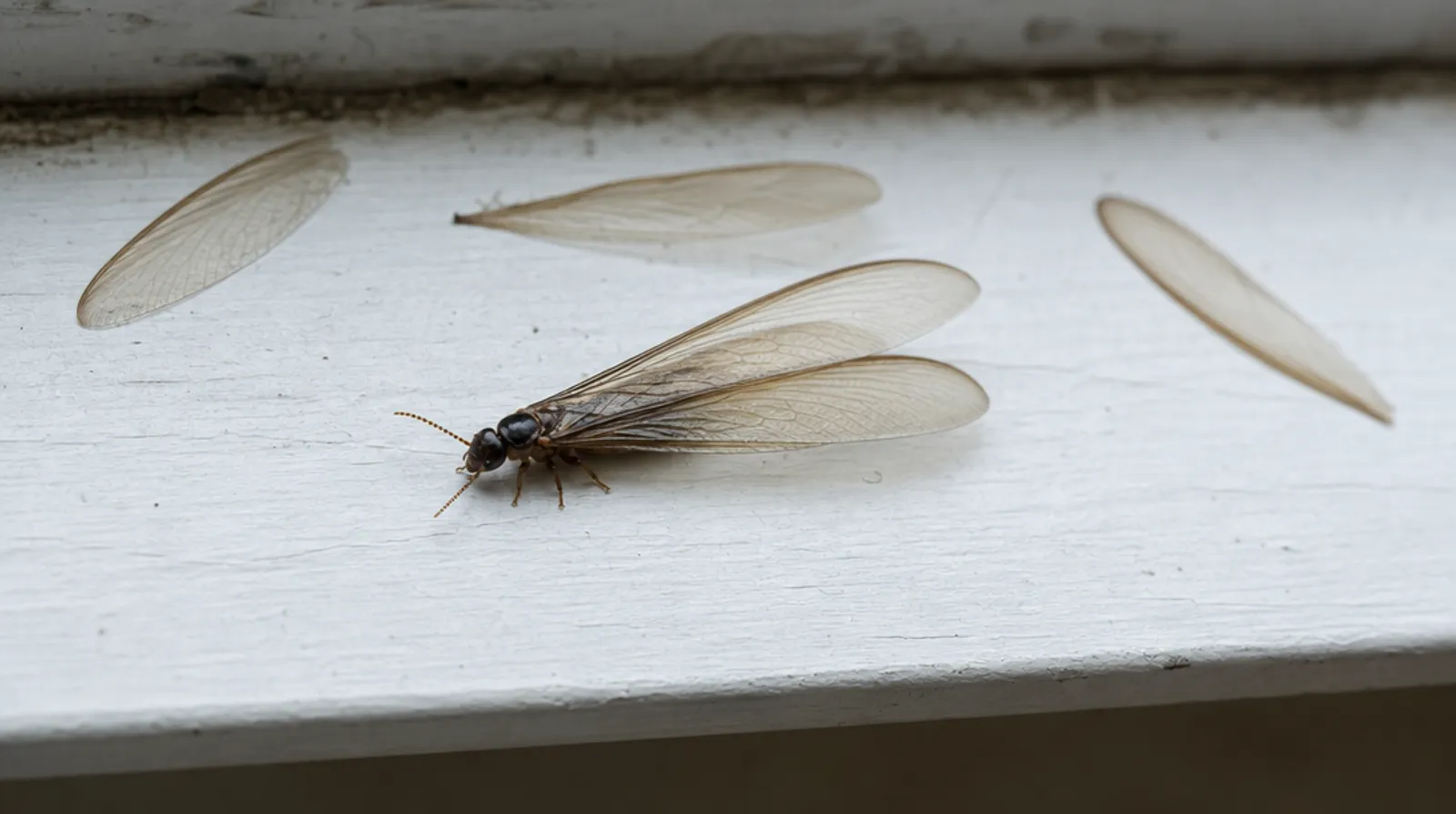
- Swarmers or discarded wings near windows and doors in late winter or spring
- Bubbling paint or warped baseboards that hide galleries underneath
A full photo checklist is in our signs of termites guide.
Do subterranean termites fly?
Only swarmers do. Subterranean termites with wings — the dark, 3/8-inch alates — leave the colony to mate and start new nests, typically on warm days after rain, from late winter through spring depending on the region. Finding winged termites indoors means a mature colony is active in or under the structure, not a stray bug problem.
How subterranean termites are treated
Because the colony lives in the ground, treatment targets the soil: a liquid termiticide barrier trenched and drilled around the foundation (typically $225–$2,500 per treatment) or termite bait stations installed around the perimeter ($7–$12 per linear foot). The two approaches are compared in detail in liquid vs. bait treatment, and method-by-method pricing is in the treatment cost guide.
Drywood Termites
Drywood termites break the subterranean rulebook: they need no soil contact and no outside moisture. A colony lives entirely inside the wood it eats — attic framing, fascia boards, window trim, hardwood floors, even furniture — extracting water from the wood itself.
Because nothing connects them to the ground, they spread differently: a single swarmer pair flying in through a vent, or an infested piece of furniture or lumber carried into the house. They are concentrated in warm coastal and southern regions — Florida, the Gulf Coast, southern California, Arizona and Hawaii.
The giveaway sign is frass: piles of tiny, hard, six-sided pellets that the colony pushes out of “kick-out holes,” often found on windowsills or below baseboards (detailed identification in the termite droppings guide). Drywood termites do not make mud tubes — if you see tubes, you are dealing with subterranean termites. Pellets that resemble coarse sand or coffee grounds, plus winged swarmers appearing at night near lights in summer and fall, point to drywood. The full species profile — identification, range, signs and treatment pricing — is in the drywood termites guide.
What kills drywood termites
The answer depends on how much of the house is infested:
- Whole-structure fumigation (tenting) — the standard when colonies are widespread or hidden in inaccessible framing; typically $2,000–$8,000 depending on home size. See the fumigation guide for process and prep.
- Local (spot) treatment — injecting termiticide foam or dust directly into the infested wood, or heat-treating a single area; works when the infestation is confirmed to be one accessible colony.
- Wood replacement and borate treatment — practical for one infested beam or trim piece.
Formosan Termites
The Formosan subterranean termite — often called the “super termite” — is an imported species that behaves like a subterranean termite scaled up by an order of magnitude. Where a native subterranean colony holds a few hundred thousand workers, a Formosan colony can hold several million and consume wood fast enough to cause serious structural damage in months rather than years.
Two traits make it especially dangerous:
- Aerial nests. Formosan colonies can build “carton” nests inside walls and attics with no ground contact at all, as long as a moisture source (a roof or plumbing leak) exists. Treating the soil alone may not reach them.
- Night swarms. Formosan swarmers — about 1/2 inch, yellowish-brown — fly at dusk and after dark, attracted to lights, usually from late spring into summer.
Formosan termites are established mainly along the Gulf Coast and in Florida, Louisiana, Texas, South Carolina, Hawaii and parts of southern California. Treatment combines aggressive baiting with soil barriers and removal of aerial nests, and tends to sit at the top of the cost ranges. If you are in their territory, a termite bond with a damage-repair clause is worth pricing out. The full species profile — identification, carton nests, swarm behavior and control — is in the Formosan termites guide.
Dampwood Termites
Dampwood termites are the least of a homeowner’s worries. They only colonize wood with high moisture content — rotting logs, leaking window frames, wood buried in wet soil — and are mostly found in the Pacific Northwest and coastal California. They rarely infest sound, dry structural lumber.
There is usually no chemical treatment involved: fix the leak or drainage problem, remove and replace the decayed wood, and the colony dies with its habitat. If dampwood termites are in your framing, the real problem is the moisture — treat that as the priority repair.
Subterranean vs. Drywood: The Difference That Decides Treatment
The difference between subterranean termites and drywood termites is the single most useful identification a homeowner can make, because the treatments do not overlap:
| Subterranean | Drywood | |
|---|---|---|
| Colony location | In soil, workers commute into wood | Inside the wood itself |
| Moisture needed | Yes — needs soil moisture | No — lives in dry wood |
| Signature evidence | Mud tubes, mud in galleries | Frass pellets, kick-out holes |
| Swarmers | Dark body, daytime swarms, late winter–spring | Lighter body, evening swarms, summer–fall |
| Damaged wood | Thin, layered, mud-packed galleries | Clean galleries, smooth inside |
| First-line treatment | Soil barrier or bait stations | Fumigation or local treatment |
One caveat: in the Southeast and Gulf states, houses can carry both types at once. If you see mud tubes on the foundation and frass in the attic, assume two infestations and two treatments. A licensed termite inspection — typically $75–$250, often free with a treatment quote — is what settles the question.
Which Types Live in Your State?
Termite pressure is not uniform. Alaska has no established termites; the Deep South and Hawaii have the heaviest pressure, including Formosan; the Southwest mixes subterranean and drywood; the northern tier mostly deals with subterranean only. State rules on licensing and real-estate inspection paperwork also vary — see the state termite guides for your state’s species, swarm season and typical prices.
Whichever type you have, the next steps are the same: confirm the species, then match the method — the termite treatment guide walks through every option, and the signs guide helps you document what you are seeing before the inspector arrives.
Frequently asked questions
Which type of termite is most destructive?
How do I know which type I have?
What is the most common type of termite in the US?
Do subterranean termites fly?
Are drywood termites hard to get rid of?
Can a house have more than one type of termite?
Last updated: 2026-08-19