What Do Termites Look Like? Identification, Eggs & Nests
Quick answer
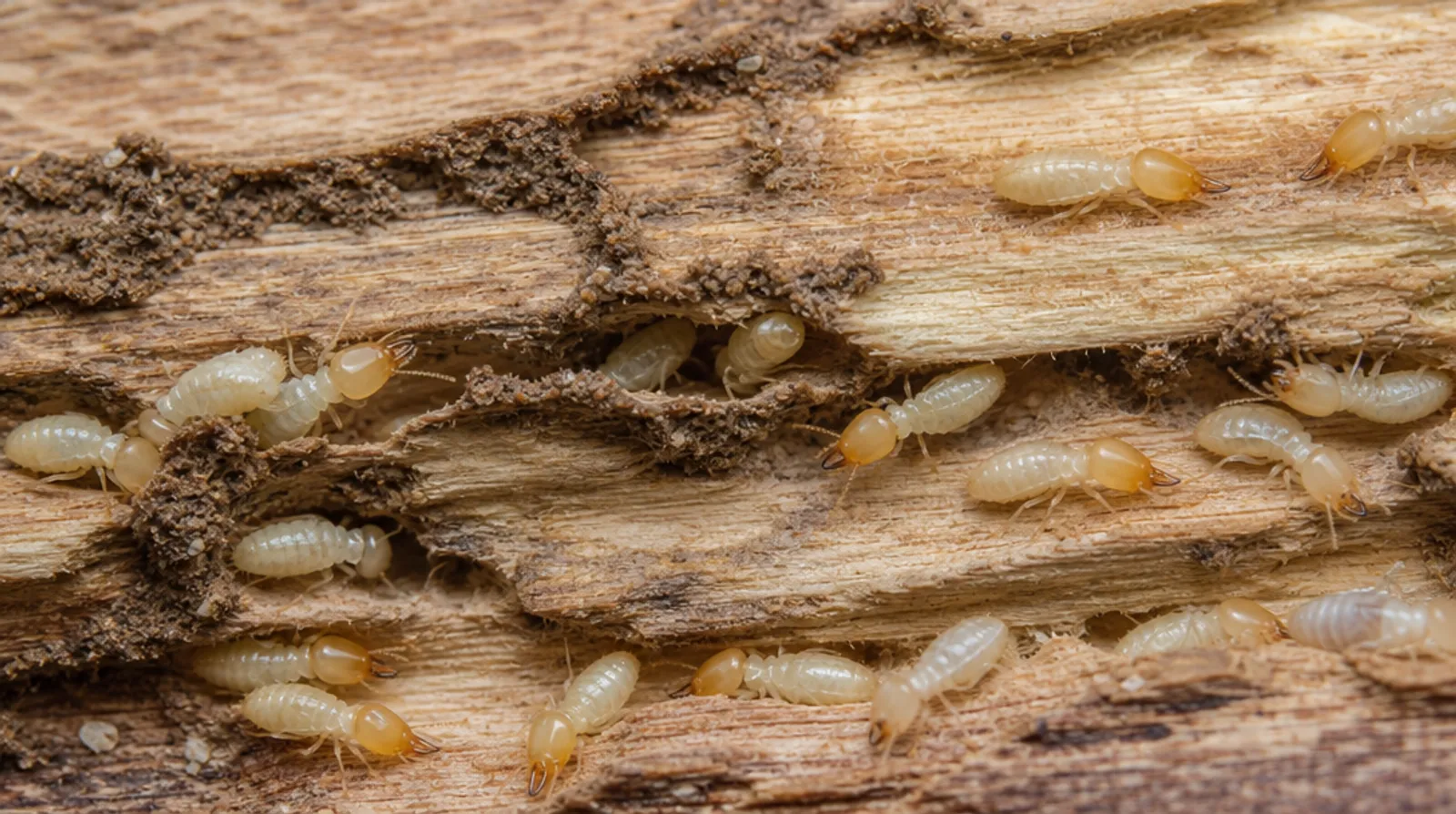
Termites are small, pale, soft-bodied insects that eat cellulose — mostly wood. Workers are cream-colored and ant-sized; swarmers (the flying stage) are dark with two equal pairs of wings. A colony is a caste system: workers, soldiers and reproductives, and it can eat a home's framing for years undetected.
Termites are among the oldest insects on earth and among the most expensive to share a house with: roughly $5 billion in US property damage a year, almost none of it covered by homeowners insurance.
This guide covers the basics — what termites look like at each life stage from egg to swarmer, how a colony is organized, where nests are built and why the insects stay hidden — as the foundation for the species and signs guides that follow.
What Are Termites?
Termites are small, social insects that feed on cellulose, the main structural component of wood, paper, cardboard and plant fibers. Special microbes in their gut let them digest cellulose that almost no other household pest can touch — which is why a colony treats your wall studs, floor joists and even paperback books as food.
Despite the old nickname “white ants,” termites are not ants. Evolutionarily they sit much closer to cockroaches. What they share with ants is the social structure: a termite colony is a true caste society with a queen, and every member has a fixed job for life.
A single colony can range from a few thousand insects (young drywood colonies) to over a million (mature subterranean or Formosan colonies). The colony works around the clock, 365 days a year, which is what makes the damage cumulative and expensive.
What Do Termites Look Like?
Termites look different depending on their caste, and that is where most identification mistakes come from. The table below covers the three castes you are most likely to encounter:
| Caste | Color | Size | Key features | Where you see it |
|---|---|---|---|---|
| Worker | Pale cream, translucent | 1/8–3/16 in (grain of rice) | Soft body, no wings, small head | Inside damaged wood, mud tubes |
| Soldier | Pale body, darker amber/brown head | Slightly larger than worker | Enlarged head, prominent dark jaws | Same places as workers, in smaller numbers |
| Swarmer (alate) | Dark brown to black | 3/8–1/2 in with wings | Four equal, translucent wings; straight antennae | Flying near windows/lights in swarm season, or as piles of shed wings |
Workers
Workers are the caste that actually eats your house — and the one homeowners almost never see, because workers avoid light and dry air. They are soft-bodied, pale and roughly ant-sized. If you break open a mud tube or a piece of infested wood and see small cream-colored insects moving away from the light, those are workers.
Soldiers
Soldiers have the same pale body as workers but a noticeably larger, darker head with strong mandibles built for defense. They cannot feed themselves — workers feed them — and they make up only a few percent of the colony. Their oversized heads are a quick confirmation that you are looking at termites, not ants.
Swarmers (the flying stage)
Swarmers are the only termites most homeowners ever see. Once or twice a year, a mature colony releases winged reproductives that fly off to pair up and found new colonies. They are dark-bodied with four equal, papery wings that are longer than the body — and they shed those wings almost immediately after landing. Piles of identical discarded wings on a windowsill are a classic warning sign; our signs of termites guide covers this and other red flags in detail.
Termite Eggs and Life Cycle
Termite eggs are tiny — about 1/25 inch — white or translucent, and shaped like a small jelly bean. You will not see them without opening a nest or a piece of heavily infested wood: the queen lays eggs deep inside the colony, and workers constantly groom and relocate them to protected nursery chambers.
The life cycle runs egg → larva → nymph → adult caste:
- Egg. Hatches in roughly two to four weeks depending on species and temperature.
- Larva. A pale, soft immature stage that molts several times.
- Nymph. Molts again into a worker, soldier or reproductive. Nymphs that grow wing buds are on the path to becoming swarmers.
- Adult. Workers and soldiers are sterile and live one to two years; reproductives pair up, shed their wings and become a new king and queen.
The queen is the engine of the colony. A mature subterranean termite queen can lay thousands of eggs per day and live 15 to 25 years. As long as the queen survives, the colony rebuilds — which is why effective treatment has to reach the whole colony, not just the insects you can see.
Termite Nests: Where Colonies Live
Where a termite nest sits depends on the species, and it determines how the insects get into your home:
| Species type | Nest location | How it reaches your house |
|---|---|---|
| Subterranean | Underground, in soil | Builds pencil-width mud tubes up foundations to reach wood |
| Formosan (a subterranean type) | Soil, plus aerial “carton” nests inside walls | Mud tubes; carton nests let it stay inside a moist wall void |
| Drywood | Directly inside the wood it eats | Swarmers fly in and nest in attic framing, trim, furniture |
| Dampwood | Wet, decaying wood outdoors or in structures | Only infests wood with moisture problems — leaks, rot |
The important point for a homeowner: you almost never find the nest itself. What you find are the traces — mud tubes on a foundation wall, shed wings, hollow-sounding wood, or the small pellets (frass) that drywood termites push out of their galleries. Identification by evidence is covered in our signs of termites guide; species-level detail is in types of termites.
How a Termite Colony Works
A colony is not a swarm of individuals — it behaves more like one organism:
- Workers do the eating, tunneling, feeding of other castes and nest maintenance. They are the damage.
- Soldiers defend the colony, mainly against ants, their natural enemy.
- Reproductives — the queen, king and seasonal swarmers — handle reproduction only.
- The queen can live for decades, keeping the colony alive even after years of foraging losses.
Colonies forage blindly and continuously. Workers follow moisture and chemical trails, and once they find a food source — a joist, a subfloor, a stack of cardboard in a crawl space — they recruit more workers to it. There is no “off season” indoors: in heated structures and warm climates, feeding continues year-round.
Where Termites Live in the US
Termites exist in every state except Alaska, but pressure varies sharply. The heaviest activity runs through the Southeast, Gulf Coast, Hawaii and Southern California, where warm temperatures and humidity let subterranean and Formosan colonies grow fast. Northern states still get subterranean termites — just slower, smaller colonies.
Risk zone, species mix and swarm season all differ by state, and so do licensing rules and disclosure requirements. See our state-by-state termite guides for what lives in your area and when it swarms.
Termites vs Ants: The 3-Point Check
Swarming termites are constantly confused with flying ants. Three field checks settle it in seconds:
| Feature | Termite | Ant |
|---|---|---|
| Antennae | Straight, bead-like | Elbowed (bent) |
| Waist | Broad — body is one continuous tube | Pinched “wasp waist” |
| Wings (swarmers) | Two pairs, equal length, shed easily | Front pair longer than rear pair |
Color is a weaker clue (carpenter ants are also dark), but if you find a pile of identical shed wings, that alone points to termites — ants keep their wings much longer.
Why Termites Stay Hidden
Termites are built to avoid you. Workers and soldiers are soft-bodied and dry out quickly in open air, so the colony lives entirely inside wood, soil or sealed mud tubes. Subterranean termites even eat wood from the inside out, leaving a thin painted surface that looks perfectly intact.
That is why infestations routinely run for years before discovery, and why the discovery often happens by accident — during a renovation, a real-estate inspection or when a door frame crumbles under light pressure. Once you know what termites look like and what evidence they leave, an annual termite inspection (typically $75–$250) is the cheapest way to catch activity early, before repair costs reach the damage ranges that make termites a $5-billion problem.
Frequently asked questions
What do termites look like?
Are termites ants?
Are termites dangerous to humans or pets?
How long do termites live?
Is termite damage covered by homeowners insurance?
Can I sell a house that has termites?
Where do termites come from?
Last updated: 2026-08-19