Flying Termites: What Swarmers Mean & What to Do
Quick answer
Yes, termites fly — once a year mature colonies release winged reproductives, called swarmers or alates, that leave to pair up and found new colonies. A swarm outdoors near your home means termites live in the area and warrants an inspection; a swarm indoors means a colony is almost certainly established in or under the structure. Do not spray or clean up the evidence — photograph it and book a professional inspection.
Yes, termites fly — and seeing them is one of the few moments a hidden colony announces itself. Flying termites are not a separate species: they are the winged reproductive stage, called swarmers or alates, that every mature termite colony produces once a year to spread.
A swarmer’s only job is to leave the nest, pair up, shed its wings and become the king or queen of a new colony. Workers and soldiers — the castes that eat wood — stay hidden for life. That makes the swarm the single most useful early-warning signal a homeowner gets, and this guide covers how to read it: when different species swarm, what a swarm inside versus outside means, how to tell swarmers from flying ants, and what to do next.
What Are Termite Swarmers?
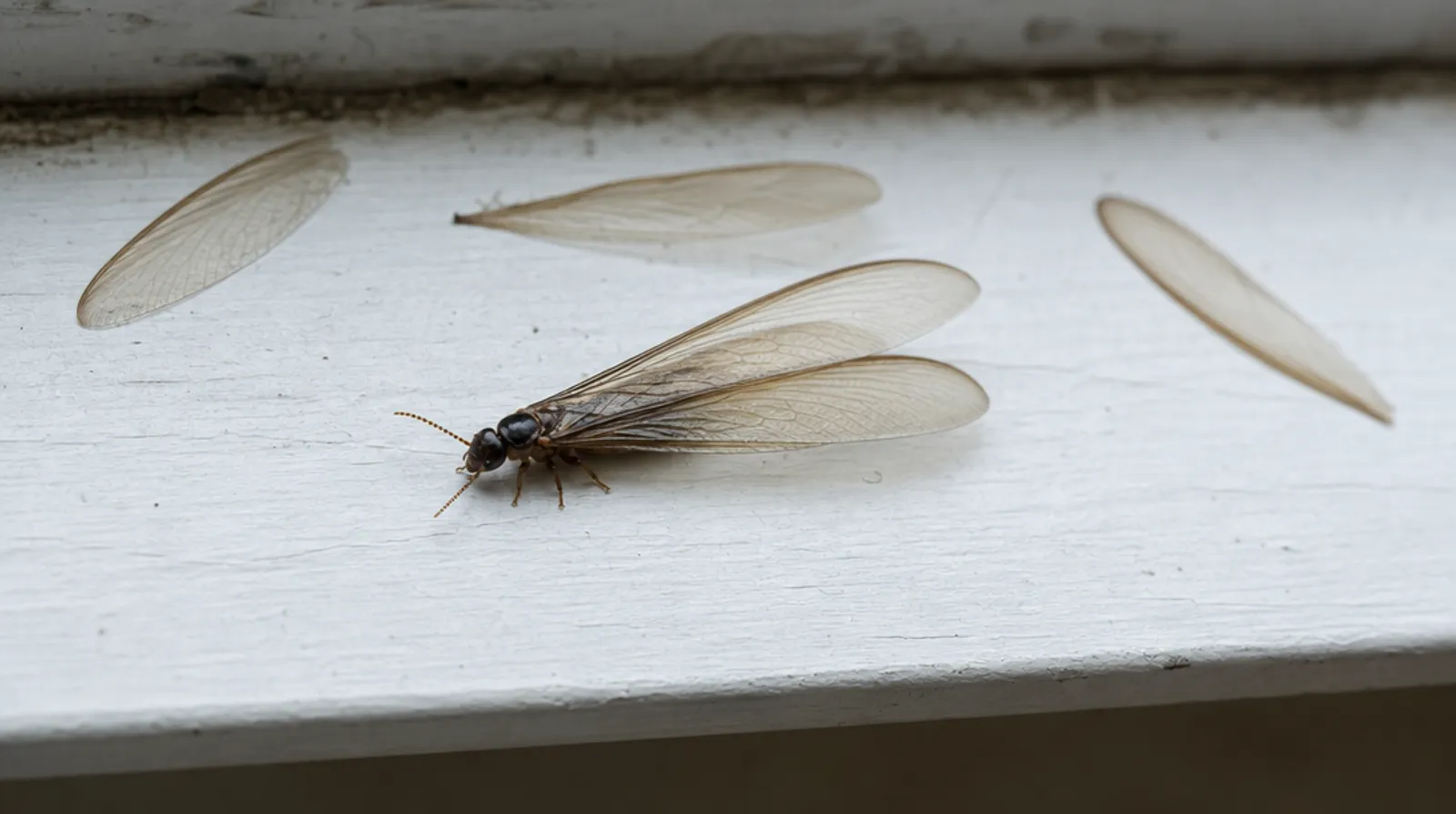
Swarmers are adult reproductive termites with two pairs of long, translucent, equal-length wings — noticeably longer than the body. They are dark brown to black, straight-antennaed and thick-waisted, which distinguishes them from flying ants at a glance.
A colony does not produce swarmers until it is mature — typically three to five years old and numbering in the tens of thousands or more. When conditions align, the colony releases hundreds to thousands of alates at once. The flight is brief and clumsy: swarmers are weak fliers, most travel only a few hundred feet, and the vast majority die without founding anything. The few that succeed land, shed their wings, pair off and burrow into soil or wood to start a colony that will not swarm again for years.
The background on colony structure and life cycle is in our what are termites guide; the rest of this page focuses on the swarming event itself.
When Do Termites Swarm?
Swarm timing is species-specific and weather-driven. Most species swarm when temperature and humidity peak after rain, because damp air and soft soil give the new pairs their best survival odds.
| Species | Season | Time of day | Trigger |
|---|---|---|---|
| Subterranean (eastern, western) | Spring (late winter in the Deep South) | Daytime | Warm day after rain |
| Formosan subterranean | Late spring | Night, around lights | Warm, humid evenings |
| Drywood | Late spring into summer (fall in some coastal areas) | Dusk | Warm, calm evenings |
Regional variation matters. In the northern half of the country the season compresses into a few spring weeks. In the South — Florida, the Gulf Coast, South Texas, Hawaii — swarm season starts earlier, runs longer, and stacks species on top of each other: subterranean termites swarm roughly February through April in South Florida, Formosan termites follow in late spring at night, and drywood termites run late spring into summer at dusk. Local timing for your area is in our state-by-state termite guides.
The practical takeaway: a daytime swarm after spring rain points to subterranean termites, a nighttime cloud around your porch light in May or June points to Formosans, and a quiet scattering of wings at dusk in summer points to drywood. Each species implies a different colony location and a different treatment.
Swarmers Inside vs Outside: What Each Scenario Means
Location is the single most important fact about a swarm.
A swarm outside — around a tree stump, fence post, woodpile or the neighbor’s wall — confirms that a mature colony lives somewhere nearby. Swarmers drift, so the colony is not necessarily in your house, or even on your lot. In high-pressure regions, outdoor swarms are seasonal background noise. Still, it means pressure is real and close, and it is a sensible trigger for a one-time inspection if you have not had one recently.
A swarm inside is different. Subterranean swarmers emerging indoors — from baseboards, window frames, plumbing penetrations, expansion joints — means the colony has reached or entered the structure itself: either a nest under the slab or in the soil against the foundation, or (with drywood and Formosan termites) a colony living directly inside the wood or wall voids. Drywood swarmers found only in one room often mean the colony is in that room’s framing or furniture.
The evidence often outlasts the event. Because swarmers shed their wings within minutes of landing, the classic find is a pile of identical, papery wings on a windowsill, along a door threshold, around a light fixture or caught in spider webs — with no insects anywhere in sight. Those wings carry the same meaning as the live swarm, and they are one of the five classic warnings in our signs of termites guide.
Flying Termite vs Flying Ant
Roughly half the “termite swarms” homeowners report turn out to be flying ants, which swarm in the same seasons. Three body features settle the question in seconds:
| Feature | Termite swarmer | Flying ant |
|---|---|---|
| Antennae | Straight, bead-like | Elbowed (bent) |
| Waist | Broad, no pinch | Narrow, pinched |
| Wings | Two pairs, equal length, shed easily | Front pair longer than rear pair |
Two supporting clues: a pile of shed wings points to termites (ants keep their wings much longer), and uniform pellet droppings near the site point to drywood termites, not ants. If you cannot tell, collect a few specimens in a sealed bag — any inspector will identify them. The full comparison, including look-alikes beyond ants, is in our termites vs ants guide.
Do Flying Termites Cause Damage?
The swarmers themselves cause none. They have functional jaws but do not feed — they live off stored reserves for the short span between flight and founding a nest. Swatting every swarmer you see would change nothing about your home’s condition.
The damage question is about what the swarm implies. A colony only swarms once it is mature, which means it has already been feeding for several years. If that colony is in or under your house, the feeding has been happening in your framing, subfloor or trim the whole time — silently, from the inside out. Scale matters too: a mature native subterranean colony eats on the order of a pound of wood a day collectively, while Formosan colonies run an order of magnitude larger and hollow structural members far faster. The other damage risk is forward-looking: every pair of swarmers that lands in a crack near your foundation or an attic vent can seed the next colony.
So treat a swarm not as the problem but as a dated, witnessed data point: a mature colony exists, and its location relative to your house determines the urgency.
What to Do If You See Flying Termites
- Do not spray them or destroy the evidence. Household insecticide kills the swarmers in the air and nothing else — the colony is untouched, and scattered, sprayed evidence makes the inspector’s job harder. Leave mud tubes and emergence points intact.
- Document everything. Photograph the insects, the shed wings and exactly where they emerged — baseboard, window frame, light fixture. Keep a few specimens in a sealed bag or tape one to an index card.
- Note the conditions. Time of day, weather, and whether the swarm was indoors or out — this helps narrow the species from the swarm calendar above.
- Book a professional inspection. A licensed termite inspection typically costs $75–$250 and is often free if treatment follows. The inspector identifies the species, maps how far the colony has spread and puts findings in writing.
- If confirmed, compare treatment options. Liquid soil treatments and bait systems generally run $225–$2,500 for subterranean termites; widespread drywood infestations may need whole-structure fumigation at $2,000–$8,000. Detail is in our termite treatment cost guide.
- If you are buying or selling, a swarm during the transaction period goes straight into the inspection paperwork — the termite letter (WDIR) documents evidence of exactly this kind.
One more thing not to do: assume it will pass on its own. Swarms last under an hour and the insects vanish, which makes the event easy to forget. The colony that produced it does not vanish — it keeps feeding, and it will swarm again next year from a larger base.
Frequently asked questions
Do termites fly?
Why do flying termites suddenly appear?
Are flying termites dangerous?
What attracts termite swarmers?
How long does a termite swarm last?
Do swarmers outside mean I have termites?
Last updated: 2026-08-24